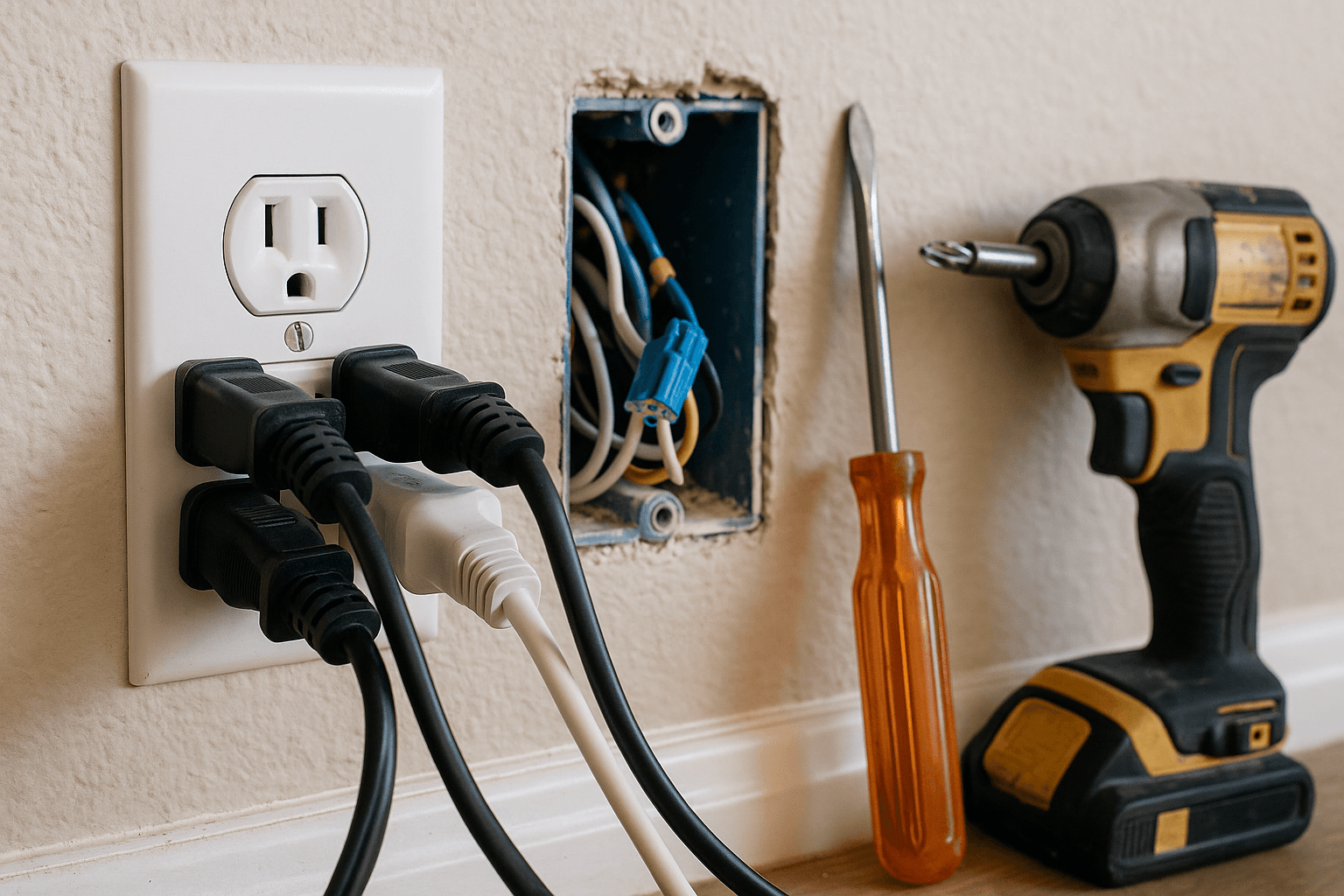
Picture this: you’re in the middle of blending a morning smoothie, the toaster is down, and someone decides to fire up the hair dryer in the bathroom down the hall—then suddenly, click, silence. The hum of the refrigerator stops, the lights flicker out, and you’re left standing there with a half-blended drink and a mild sense of panic. It’s annoying, sure, but that little click is actually your home’s way of screaming for help before something melts.
Why Your House Can’t Keep Up With Your Gadgets
Here’s the thing about houses, especially if you’re living in one of the older neighborhoods here in Chandler. They were built for a different time. Back in the day, we didn’t have a smart speaker in every room, three monitors in the home office, and a high-speed air fryer sitting on the counter. We just had a TV, a lamp, and maybe a VCR.
Honestly, our electrical consumption has skyrocketed, but our walls are still hiding the same wiring from twenty or thirty years ago. It’s like trying to force water from a fire hose through a garden straw; eventually, something is going to burst. In the electrical world, that “burst” is a tripped breaker or, worst-case scenario, an electrical fire.
When we talk about electrical capacity, we aren’t just talking about adding more places to plug stuff in. We are talking about the safe distribution of power. You can’t just swap a single outlet for a quad receptacle and hope for the best. You have to know what’s going on behind the drywall.
The “Octopus” Behind the Entertainment Center
We have all done it. You buy a six-outlet power strip, plug it into the wall, and then—because you have more than six things—you plug another strip into that one. We call this daisy-chaining, and honestly, it keeps fire marshals awake at night.
It feels like a solution because everything turns on, right? But here is what is actually happening. A standard residential circuit is usually rated for 15 or 20 amps. That power strip doesn’t create more power; it just splits the existing trickle into more streams.
If you are running a gaming PC, a sound system, a TV, and charging a tablet all from one receptacle, you are likely pushing that circuit to its absolute limit. The wires inside your walls heat up as more current flows through them. The insulation degrades. Over time, this creates a major safety hazard.
So, if your outlet looks like an octopus with cords sprawling everywhere, that is your first sign that you need an upgrade.
Understanding the Math (Without the Headache)
I know, nobody likes math. But when it comes to safely expanding electrical capacity, you just need to know one simple formula: Watts divided by Volts equals Amps.
In the US, our standard voltage is 120V. If you have a 15-amp breaker (which is standard for most bedrooms and living rooms), you have roughly 1,800 watts to play with before the breaker trips. But for safety, you should never load a circuit past 80% of its capacity continuously. That means you really only have about 1,440 watts of usable power.
Let’s look at what typical Chandler homeowners are plugging in.
| Appliance | Average Wattage | Estimated Amps |
|---|---|---|
| Hair Dryer | 1,500 – 1,800 | 12.5 – 15 |
| Microwave | 1,000 – 1,200 | 8 – 10 |
| Space Heater | 1,500 | 12.5 |
| Central AC (Running) | 3,000 – 5,000 | 15 – 30 (240V) |
| Vacuum Cleaner | 1,000 – 1,440 | 8 – 12 |
| Gaming Computer | 400 – 800 | 3 – 7 |
See the problem? If you run a vacuum cleaner (12 amps) and a hair dryer (15 amps) on the same 15-amp circuit, you are trying to pull 27 amps. The breaker will pop. It has to.
The Solution: Dedicated Circuits
So, what do you do when you want to run that second fridge in the garage for your Costco runs, or you’re setting up a serious workshop? You don’t just tap into the nearest light switch. You need a dedicated circuit.
A dedicated circuit is like building a private highway for a single appliance. It runs directly from your main electrical panel to one specific outlet, bypassing everything else. This ensures that when your refrigerator compressor kicks on, it doesn’t steal power from your TV or your computer.
Common spots in Chandler homes where we frequently install dedicated circuits include:
- Garage Workshops: Power tools draw huge surges of power on startup.
- Home Offices: Computers are sensitive. You don’t want the printer causing a voltage drop that crashes your PC.
- Kitchen Upgrades: If you’re adding a wine fridge or a high-end espresso machine, the existing kitchen loop probably can’t take it.
- Holiday Lights: Yes, come December, everyone daisy-chains cords across the front lawn. A dedicated exterior outlet saves you a lot of headaches.
Signs You Are Overloading Your System
Sometimes the signs are subtle. It’s not always a dramatic pop and darkness. If you notice these things, your home is trying to tell you something:
- Dimming Lights: Does the living room lamp dim momentarily when the AC kicks on? That’s a voltage drop. It means the system is struggling to supply the initial surge of power.
- Warm Faceplates: Go touch the plastic cover of the outlet you use most. Is it warm? It shouldn’t be. Heat suggests resistance, and resistance leads to melting.
- Buzzing Sounds: Electricity should be silent. If you hear a faint buzzing or sizzling from an outlet, stop using it immediately. That’s arcing, and it’s a fire starter.
- The “Reset” Dance: If you find yourself resetting a GFCI outlet (those buttons in the kitchen or bath) constantly, the outlet isn’t just “finicky.” It’s detecting a fault.
Old Wiring vs. Modern Needs
Let’s talk about the history of Chandler for a second. We have a mix of beautiful new builds and charming older homes. If your house was built in the 70s or 80s, you might be dealing with insulation that has become brittle over time. Or, in rare cases, aluminum wiring, which was a cheaper alternative to copper back then but has different expansion properties that can loosen connections over time.
When we come in to add an outlet, we aren’t just cutting a hole in the drywall. We are inspecting the integrity of the existing wire. Can it handle the load? is the grounding proper?
There is also the issue of the electrical panel itself. You might have a 100-amp panel that was fine in 1995, but with two EV cars charging in the driveway and a pool pump running in the backyard, you are maxing out the whole house’s potential. Sometimes, the solution isn’t just a new wire; it’s a panel upgrade to bring more service into the home.
The “Handyman” Approach: Why Call Us?
You might be thinking, “Can’t I just watch a video online and run some wire myself?”
Technically? Maybe. But electrical work isn’t like painting a wall or fixing a leaky faucet. If you mess up a paint job, it looks ugly. If you mess up a circuit installation, the consequences are invisible until they become catastrophic.
There is a nuance to fishing wires through insulated walls without tearing up your entire house. There is a specific way to torque the screws on a breaker so it doesn’t loosen with thermal expansion. These are the things we obsess over.
At East Valley Handyman, we bridge the gap. You might not need a massive electrical contractor for a small job like adding an outlet behind a mounted TV or running power to a new ceiling fan. That’s our sweet spot. We handle the load calculations, we ensure the polarity is correct, and we make sure everything is up to code so you can sleep at night.
We also know the local quirks. We know how the heat in an Arizona attic affects wire ratings. (Yes, ambient temperature changes how much current a wire can safely carry—it’s called derating, and we account for it).
A Note on Smart Home Expansion
Recently, we’ve seen a huge uptick in homeowners wanting to install smart switches, video doorbells, and security cameras. These devices don’t draw a lot of power individually, but they often require a neutral wire at the switch box.
In older homes, switch loops often didn’t include a neutral wire because standard toggle switches didn’t need one. Now, you buy that fancy WiFi dimmer, open up the wall, and realize you’re missing a wire.
This is a classic “easy” DIY project that turns into a nightmare. We can often fish a neutral wire or reconfigure the circuit to make your smart home dreams happen without you having to hack apart your plaster.
Safety First, Convenience Second
It is tempting to just buy another extension cord. It’s cheap, it’s easy, and it solves the problem right now. But temporary solutions have a nasty habit of becoming permanent fixtures.
We see it all the time—extension cords run under rugs (a huge fire risk because they can’t dissipate heat) or stapled along baseboards. Please, don’t do this. Expanding your home’s electrical capacity is an investment in safety and convenience. Plus, having an outlet exactly where you need it—right by the nightstand, or inside the pantry for the microwave—is a small luxury that makes daily life so much smoother.
If you are tired of playing “breaker roulette” every time you turn on the vacuum, or if you just want to modernize your home to handle your electronics safely, let’s take a look at it. You don’t have to guess about watts and amps. That’s what we are here for.
Let’s Get Your Power Sorted
Don’t wait until the lights go out for good or you smell burning plastic. Whether you need a dedicated circuit for that new workshop tool, a GFI outlet installed in the bathroom, or just a safety check on your existing outlets, East Valley Handyman is here to help homeowners in Chandler get powered up safely.
We can assess your current load, recommend the safest path forward, and get the job done right without the hassle.
Ready to stop the overload?
Give us a call at 480-500-6935 or simply Request a Free Quote today. Let’s make sure your home can handle everything life plugs into it.