Is there anything more frustrating than a door that just won’t close right? You give it a push, it bounces back, or worse, you have to do that awkward “lift and shove” maneuver just to get the latch to click. It’s a small thing, really, but when it happens every single day, it starts to feel like your house is working against you.
The Psychology of a Sticky Door
Honestly, we don’t think about our doors much until they stop working. A door is supposed to be invisible, right? You walk through, you shut it, you move on with your life. But when it starts dragging across the carpet or squealing like a frightened cat, it breaks your flow. It’s an interruption. And here’s the thing—it’s embarrassing.
Imagine you’ve got friends over for a barbecue in the backyard. Someone goes inside to grab a drink, and you hear scrrrraaaaaape-thud. You flinch. You know exactly which door it is. It makes the whole place feel a little less put together, even if the rest of your home is pristine.
We see this all the time at East Valley Handyman. Homeowners in Chandler live with these annoyances for months, sometimes years, because they figure it’s a huge project to fix. They worry they’ll need a whole new door or a carpenter to tear out the frame. But usually? It’s just geometry and physics having a little argument.
Why Chandler Doors Act Up (It’s Not Just You)
Let’s talk about where we live for a second. We aren’t building homes in a vacuum; we’re building them in the desert. The heat here does strange things to materials. Wood is organic—it breathes. When we hit those triple-digit temps in July and then get slammed with humidity during monsoon season, wood swells. When it dries out, it shrinks.
Over time, this expansion and contraction cycle loosens screws and shifts frames. Plus, the soil conditions in the East Valley can lead to minor foundation settling. Nothing dangerous usually, just enough to throw a door frame out of square by an eighth of an inch. And an eighth of an inch is all it takes to turn a smooth swing into a daily struggle.
You also have to consider the hardware. Most builder-grade hinges aren’t designed to last forever. They fatigue. Metal wears down. Gravity wins.
The “Big Three” Door Problems
When we get a call, it’s almost always one of three things. Identifying the symptom is the first step to figuring out if you need a simple adjustment or a slightly bigger repair.
1. The Sagging Door (aka “The Top Gap”)
If you look at the top of your closed door, is the gap on the handle side wider than the gap on the hinge side? That’s a classic sag. The top hinge is pulling away from the wall, or the screws have stripped out of the wood. The door is literally leaning down, causing the bottom corner to drag on the floor or the top corner to hit the jamb.
The Fix: This is one of our favorite fixes because it feels like magic. We often swap out the short little screws the builder used with 3-inch heavy-duty screws. These long screws bypass the door jamb and bite deep into the structural stud behind it, pulling the whole door back into alignment. It’s satisfying to watch the gap close up instantly.
2. The Latch That Won’t Catch
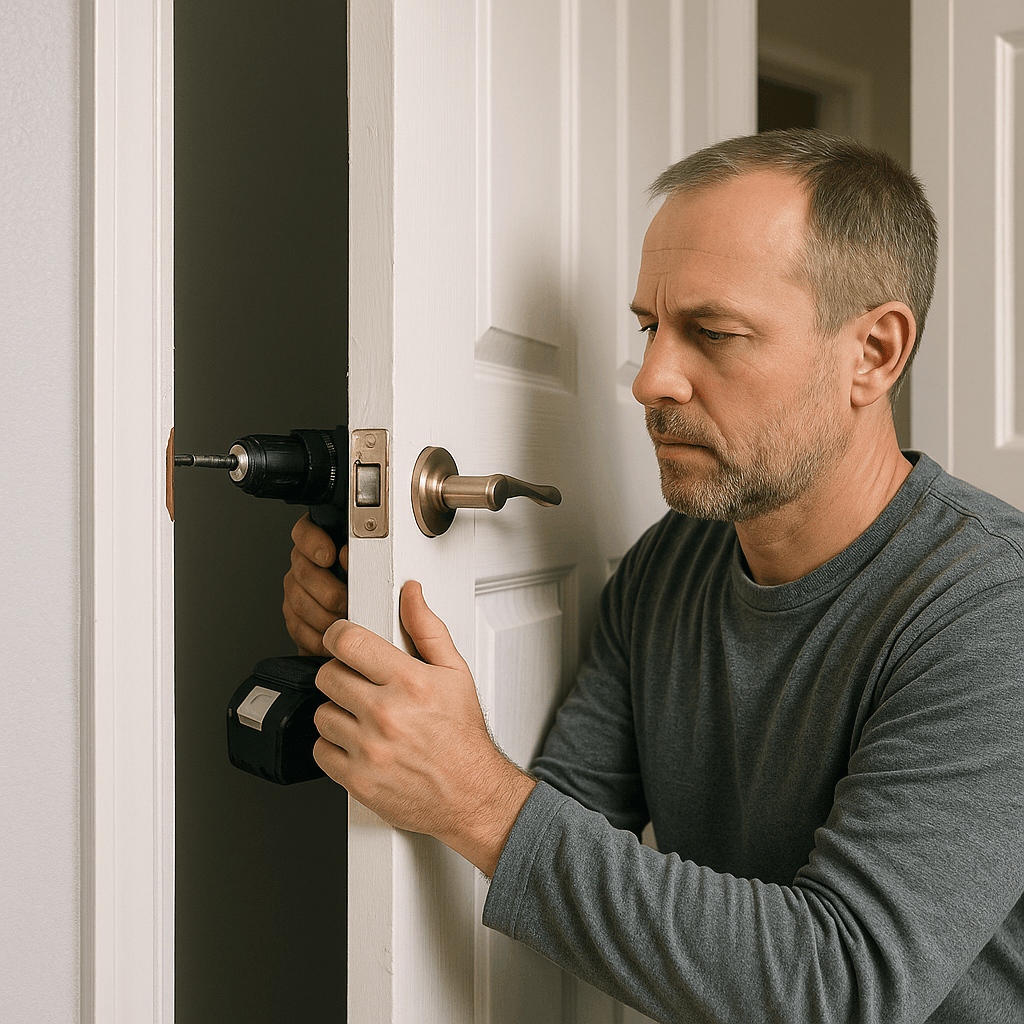
You close the door, but it doesn’t stay closed. A stiff breeze blows it open. This usually happens because the strike plate (that metal piece on the frame) is no longer aligned with the latch on the door. The house settled, the door dropped, and now the latch hits the metal instead of falling into the hole.
The Fix: Sometimes we can file down the metal plate just a smidge. Other times, we need to relocate the plate entirely. It’s precise work—move it too far, and the door rattles; don’t move it enough, and it still won’t click.
3. The “Ghost” Door
You open a door to walk through, and it slowly swings shut behind you to hit you in the heel. Or, you shut it, and it drifts open. This is a balance issue. The hinges aren’t plumb (vertically straight).
The Fix: We have a few tricks here. Sometimes it involves bending the hinge pin slightly to create friction—just enough to hold the door in place without making it hard to move. It’s an old carpenter’s trick, but it works better than shimming the entire frame in most cases.
A Note on Sliding Glass Doors (The Chandler Essential)
We have to mention sliders because almost everyone in Chandler, AZ has one leading to the patio. These things take a beating. Between the dust from the occasional haboob and the constant traffic in and out of the pool, the tracks get gritty.
If your sliding door sounds like a freight train when you move it, or if you need two hands and a deep breath to pull it open, your rollers are likely shot.
A lot of people try to fix this by spraying WD-40 on the track. Please don’t do this. WD-40 attracts dirt. It turns that desert dust into a black, sticky sludge that gums up the rollers even worse. You want a silicone-based lubricant or nothing at all.
Replacing rollers is a bit of a heavy lift—literally. We have to take the heavy glass door off the track, flip it, remove the old corroded wheels, and install new steel or nylon rollers. But the result? You’ll be able to open that door with your pinky finger. It changes how you use your backyard.
The DIY Dilemma: When to Call a Pro
You might be thinking, “I have a screwdriver, I can probably handle this.” And for some things, you absolutely can. Tightening a loose handle? Go for it. But door geometry can be deceptively tricky.
Here is a quick breakdown of when to grab your toolbox and when to call East Valley Handyman:
| Situation | Who Should Fix It? | Why? |
|---|---|---|
| Squeaky Hinge | You | A little silicone spray usually does the trick. Easy peasy. |
| Loose Knob | You | Usually just two exposed screws. Tighten them up! |
| Door Rubbing Frame | Pro | Requires planing the wood or adjusting hinges precisely. One wrong move and the door looks chewed up. |
| Rotten Frame | Pro | This is structural. If water has damaged the bottom of the jamb, it needs to be cut out and replaced expertly. |
| Sliding Door Stuck | Pro | The doors are heavy and dangerous if they fall. Plus, aligning the lock afterward is a pain. |
There is a fine line between a quick adjustment and stripping a screw hole so badly that the hinge will never hold again. We’ve gone to plenty of jobs where we had to fix the original problem plus the damage caused by a well-meaning homeowner trying to hammer a hinge pin back into place.
The Toothpick Trick (and Other Secrets)
Since we believe in being helpful, let me share a little trade secret for those stripped screw holes. You know the ones—you turn the screwdriver, and it just spins?
If the hole is too big for the screw, take a wooden toothpick (or a golf tee for bigger holes), dip it in wood glue, and shove it into the hole. Break it off flush. Let it dry. Now, you’ve got fresh wood for the screw to bite into. It’s a classic handyman hack that saves you from having to buy larger screws or replace the wood.
But sometimes, tricks aren’t enough. Sometimes the door is warped. Wood is a natural material, and occasionally a slab door will just twist like a potato chip. No amount of hinge adjustment fixes a warped door. In that case, we have to look at replacement. But you’d be surprised how often a “ruined” door can be saved with the right know-how.
Why Expertise Matters
You might wonder why Handyman Services are necessary for something that seems so simple. It comes down to the tools and the experience.
We carry planers—tools that shave off thin ribbons of wood from the edge of a sticking door—leaving a factory-smooth finish. If you try to sand it down by hand, you’ll be there for three days and end up with a wavy edge. We carry hinge adjustment tools that can bend steel with precision. We have the correct router bits to cut new mortises if the hinges need to move.
It’s also about assessing the root cause. A sticking door might actually be a sign of a floor joist issue or a water leak swelling the subfloor. A pro looks at the door, but sees the house.
Peace of Mind is Quiet
There is something strangely peaceful about a house that works. When you close the bathroom door and it clicks softly shut—no shoving, no noise—it feels luxurious. It feels like things are under control.
We know homeowners in Chandler take pride in their properties. Whether you’re in a stucco home in Ocotillo or a ranch style closer to downtown, your home is your sanctuary. You shouldn’t have to fight it.
Closing the gap on your door problems isn’t just about functionality; it’s about restoring that feeling of quality to your home. You don’t have to live with the squeaks, the drags, and the drafts.
Let’s Get That Door Fixed
If you are tired of hip-checking your front door to get it open, or if that sliding glass door sounds like a heavy metal concert every time you let the dog out, it’s time to get it sorted.
At East Valley Handyman, we handle these small annoyances so you can get back to enjoying your home. We’re local, we know the Chandler area, and we know exactly how to handle the quirks of Arizona homes.
Don’t struggle with it another day.
Give us a call at 480-500-6935 to schedule a repair.
Prefer to do things online? Request a Free Quote on our website and let us know what’s going on. We’ll get it swinging smooth in no time.