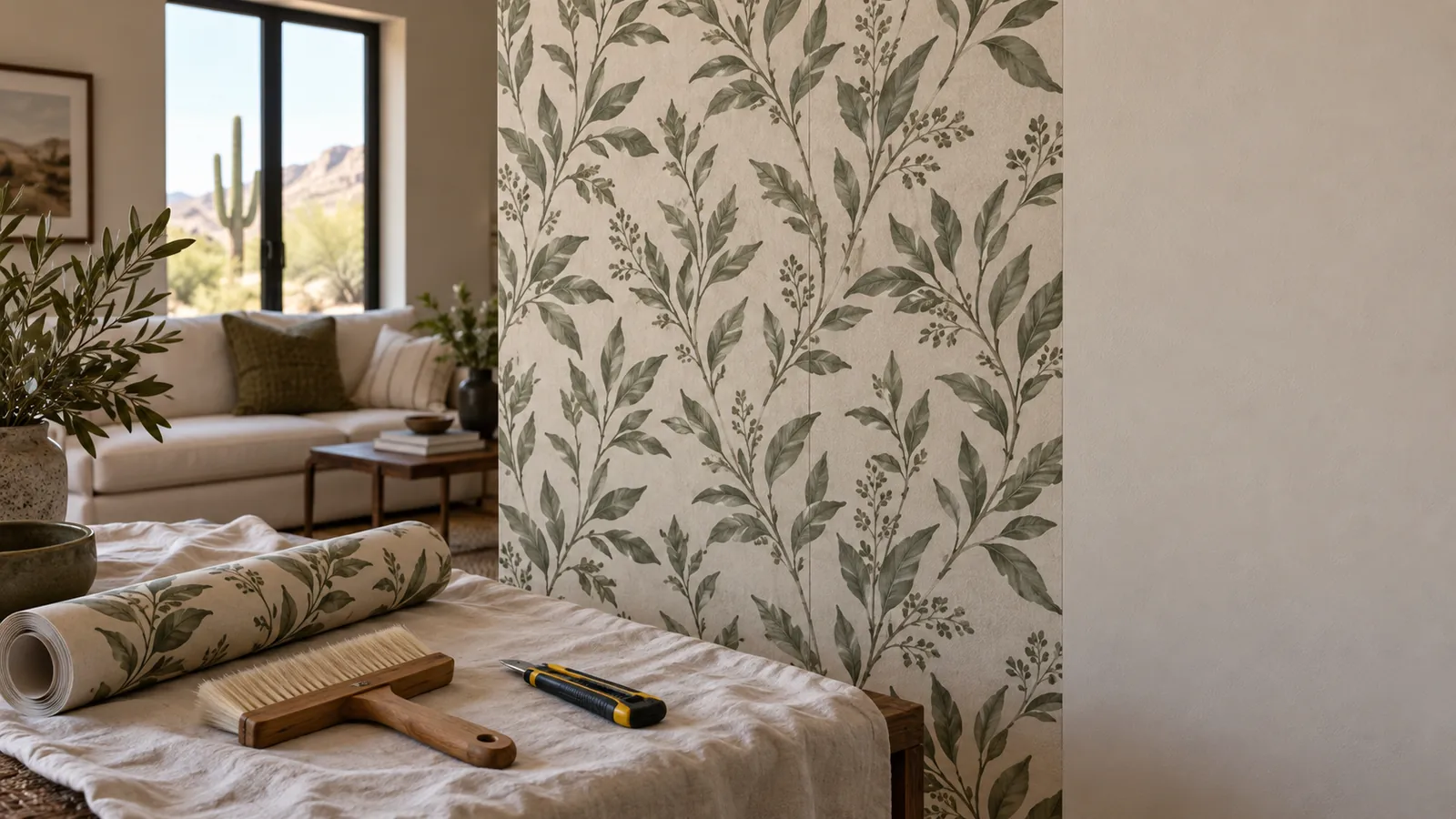
You know that feeling when you walk into a room and it just feels… flat? You’ve painted the walls a nice shade of “Agreeable Gray,” bought the mid-century modern furniture, and added a few plants, but something is still missing. It lacks that punch, that personality that screams you. That’s usually the moment people start scrolling through Pinterest and stumble upon the glorious comeback of wallpaper. But here’s the thing: falling in love with a pattern is the easy part; getting it on the wall without losing your mind is a whole different story.
Wait, Wallpaper is Cool Again?
Honestly, if you haven’t looked at wallpaper in the last decade, you might still be traumatized by memories of fuzzy florals or that weird, peeling fruit border in your aunt’s kitchen. But let’s be real for a second, wallpaper has had a serious glow-up.
It’s one of the quickest ways to take a space from boring to bold. Whether it’s a powder room that feels like a jewel box or a nursery that needs a touch of whimsy, wallpaper adds depth that paint just can’t compete with.
But there is a catch.
It looks like a fun weekend project. You think, “It’s just stickers for adults, right?” Wrong. It is a precision sport. One slip-up, one air bubble, or one mismatched pattern, and that expensive roll of paper becomes a permanent reminder of a Saturday gone wrong.
Review the scope before hiring
Let’s talk about the elephant in the room: Peel and stick wallpaper.
Marketing teams have done a fantastic job convincing homeowners in Chandler that this is a DIY dream. They make it sound like you just peel the back off, slap it on the wall, and boom, instant luxury.
Here is the reality check. Peel and stick can actually be harder to work with than traditional paste wallpaper. Why? Because once it sticks, it sticks. With peel and stick, if you don’t get it right the first time, you are peeling paint off the wall trying to fix it.
And have you ever tried to hold a 12-foot strip of sticky vinyl while standing on a step ladder, trying to match a complex geometric pattern, all while gravity is working against you?
The Chandler Factor: Dealing with Textured Walls
Orange peel, knockdown, skip trowel, builders here went crazy with the drywall mud.
While texture hides imperfections in the drywall, it is the absolute enemy of wallpaper.
Well, you can, but it will look like a bumpy mess, and the adhesive won’t bond correctly. The pattern will look distorted, and within a few months, those seams are going to start lifting.
This is where a professional Wallpaper Handyman earns their keep. This usually involves a process called skim coating .
What is Skim Coating?
It sounds technical, but it’s basically applying a thin layer of joint compound over your textured wall to create a glass-smooth surface. It’s dusty, it takes a steady hand, and it has to be sanded perfectly flat. It’s the difference between a high-end hotel look and a DIY disaster.
Precision is the Name of the Game
You might be handy. Maybe you’ve built a deck or fixed a leaky faucet. But wallpapering requires a different kind of patience. It’s less about muscle and more about geometry and finesse.
- Pattern Repeat: This is the distance between where the design starts and where it starts again. If you don’t calculate this right before you cut, you’ll run out of paper halfway through the wall.
- Plumb Lines: Walls are almost never perfectly straight. If you start hanging paper based on the corner of the room, by the time you get to the other side, your pattern could be slanting downhill.
- Kill Points: This is an industry term for the corner where the last strip of wallpaper meets the first strip. The pattern usually won’t match perfectly here. A pro knows exactly where to hide this line so no one ever notices it, usually in the least visible corner of the room or above a door frame.
Tools of the Trade (That You Probably Don’t Have)
Sure, you can buy a smoothing tool at the hardware store. But a professional setup is a bit more involved.
| Tool | What It Does | Why It Matters |
|---|---|---|
| Laser Level | Projects a perfectly straight line on the wall. | Ensures your pattern doesn’t start leaning sideways three sheets in. |
| Seam Roller | Hard rubber roller for pressing down edges. | Prevents those annoying curling edges that happen a month later. |
| Snap-Off Blade Knife | A razor that is constantly sharp. | Paper tears easily when wet with paste. A dull blade ruins the cut. |
| Wallpaper Table | A long, dedicated surface for pasting. | Using your kitchen island or floor is a recipe for a sticky mess. |
The Emotional Toll of DIY (A Slight Digression)
There is a specific type of argument that happens between couples trying to hang wallpaper together. It usually starts at the second strip, right when the pattern is off by a millimeter.
One person is holding the weight of the paper, the other is squinting at the seam, and tensions rise. It’s like assembling furniture from that Swedish store, but sticky and permanent.
Hiring a handyman service is cheaper than marriage counseling. You get the “reveal” moment without the “sweating and swearing” montage.
Material Matters: Not All Paper is Created Equal
When you are browsing online, you might see a roll for \$30 and another for \$300. Is there a difference? Absolutely.
Cheap paper is thin. When you put paste on it, it can stretch and tear like wet tissue. High-quality paper, especially non-woven varieties, is dimensionally stable. It holds its shape.
Then you have the specialty stuff. Grasscloth is beautiful, it adds this organic, earthy texture to a room. But here is the kicker: you cannot get glue on the front of it. Not even a drop. If you do, it stains, and you can’t wipe it off. Water ruins it. Installing grasscloth is high-stakes gambling if you don’t know what you’re doing.
A professional knows how to handle these delicate materials.
Cost vs. Value: Are You Really Saving Money?
Let’s do some quick math. You buy \$400 worth of beautiful wallpaper. You try to install it yourself. You mess up the first two strips (it happens). Now you are short on paper. You have to order another roll, but guess what? The dye lot might be different.
Wallpaper is printed in batches. If you buy a roll a month later, the color might be ever-so-slightly different. A pro would have calculated the exact amount needed, plus overage for pattern matching, ensuring everything comes from the same batch.
Plus, think about your time. Properly prepping a wall, measuring, cutting, pasting, hanging, and cleaning up is a multi-day job for a beginner.
You spent good money on that paper; it deserves to look like a million bucks on the wall.
Beyond the Four Walls
- Cabinet Inserts: Adding texture to the back of a bookshelf or inside glass cabinet doors.
- Stair Risers: A fun pop of pattern on the vertical part of your stairs.
These small touches require intricate cutting and precise measurements. It’s fiddly work, but the payoff is huge. It makes your home look custom, curated, and high-end.
So, Is It Worth It?
But there is something uniquely satisfying about wallpaper. It changes the mood of a house instantly.
Paint sets a color; wallpaper sets a scene.
Whether you are looking for a moody, dark floral for a dining room or a bright, geometric print for a home office, the installation is just as important as the design itself. You want seams that disappear. You want corners that are crisp. You want the pattern to flow naturally around windows and outlets.
You want to walk into that room, take a deep breath, and feel that sense of “home” that was missing before.
Don’t let the fear of installation keep you from the interior design of your dreams. And definitely don’t let a DIY attempt ruin your weekend (and your walls).
Ready to Transform Your Space?
Stop staring at those swatches and wondering “what if.” Let’s get that paper on the wall and make your Chandler home shine.
Prefer to type it out? Request a Free Quote online and let’s talk about your vision.
Discuss a suitable repair
East Valley Handyman handles practical repair, mounting, assembly, patching and finish projects in Chandler and the East Valley. Send the project details so the scope can be reviewed before scheduling. Major trade work, structural repairs and permit-dependent projects need the appropriate licensed specialist.
Need a hand with a project?
Tell us what needs attention, where the work is and what you have in mind. We serve Chandler and the surrounding East Valley.
Request a free quote →