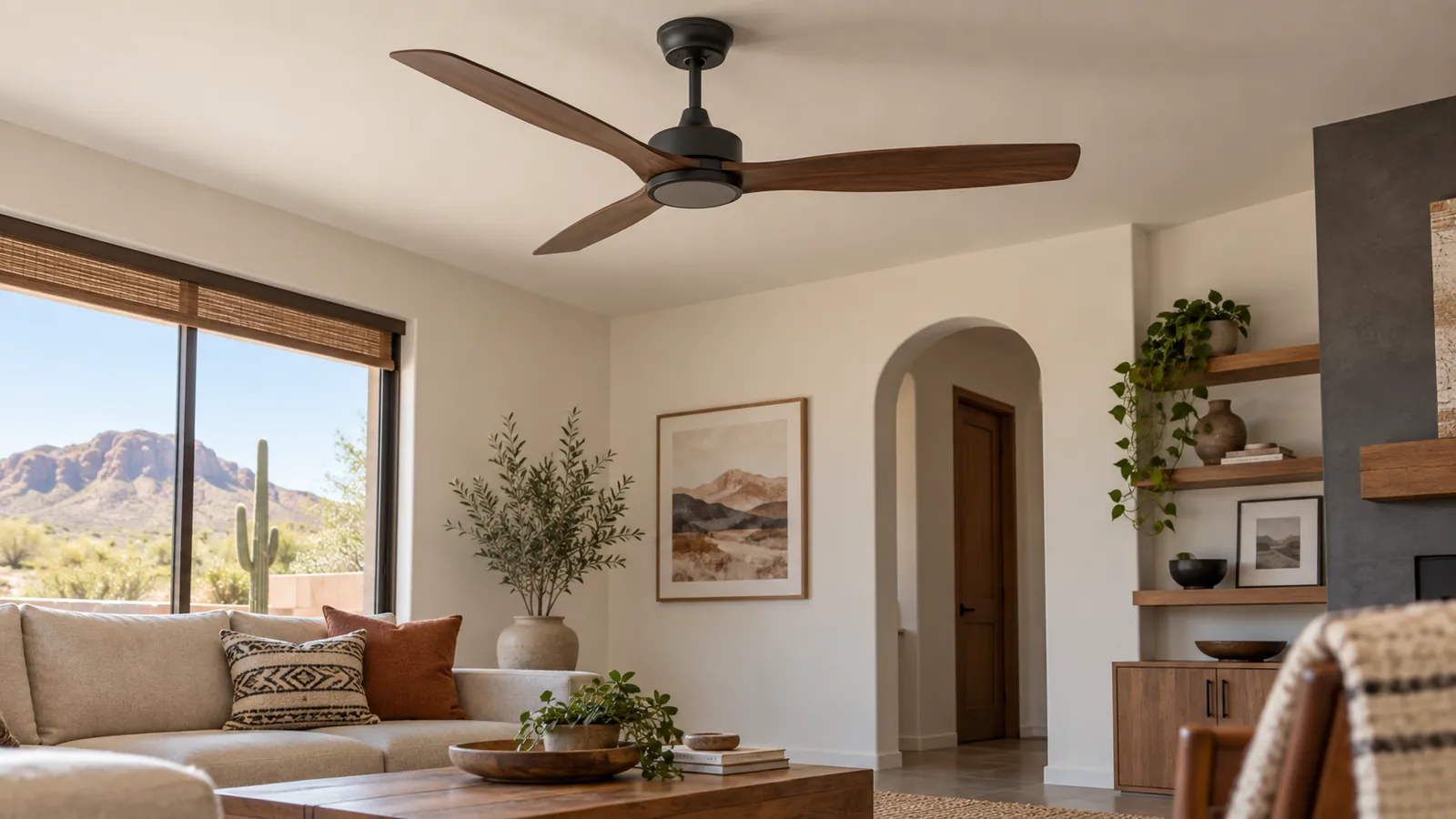
Scope and safety: This guide is for project planning, not instructions for electrical work. New wiring, circuit diagnosis, panels, service upgrades and code-dependent work need an appropriately licensed electrician. Stop using damaged or overheating equipment and keep clear of exposed wiring. Ask about a like-for-like fixture or fan project only after the existing supply and mounting have been checked.
Let’s be completely honest for a second; living in Chandler, Arizona means you are constantly looking for ways to beat the summer heat without sending your electric bill into orbit. A beautifully mounted ceiling fixture is usually the ideal answer, bringing both sweet relief and a stylish upgrade right to your living room or bedroom. But honestly, getting that heavy, awkward motor and those delicate blades secured onto your ceiling safely is a project that practically begs for a professional touch.
The Do-It-Yourself Trap: Is It Really Worth the Hassle?
You know what? You wander into a local big-box home improvement store on a Saturday morning, grab a coffee, and spot a gorgeous brushed-nickel Hunter fan on sale. It looks pretty straightforward sitting there on the shelf, doesn’t it? The packaging usually says something incredibly encouraging like “Easy 3-Step Setup!”
Here’s the thing, though. That box is lying to you.
Once you get home and tear open the cardboard, you are suddenly staring at a chaotic pile of brackets, tiny screws, washers you didn’t even know existed, and a tangle of mysterious wires. Suddenly, that quick weekend project turns into a multi-hour standoff between you and your ceiling. You are balancing precariously on a wobbly step ladder, your neck is cramping up, and you are sweating through your favorite t-shirt trying to hold a heavy motor block with one hand while twisting wires with the other.
It is pure exasperation.
Wiring a home fixture isn’t just about matching black to black and white to white. Sometimes you open up the ceiling canopy and find a chaotic rainbow of old wiring, red wires, blue wires, or grounding wires that seem to go absolutely nowhere. If your house in Chandler was built a few decades ago, there is a very good chance the existing electrical box wasn’t even designed to hold the weight of a modern fan. This is exactly where looking for local Handyman Services saves the day. A trained expert knows how to swap out a standard light box for a reinforced, load-bearing ceiling fan brace without destroying your drywall.
Wait, Fans Don’t Actually Cool the Room?
Ceiling fans do not actually lower the temperature of the room itself.
They cool you.
It is all about the wind chill effect. When those angled blades spin, they create a draft that evaporates the natural moisture on your skin, making you feel several degrees cooler than the thermostat claims. Because you feel cooler, you can nudge your AC thermostat up a few degrees, which directly saves you money.
But there is a catch. If the fan isn’t installed at the right height, usually about eight to nine feet off the floor, or if the blades are too close to the ceiling, you lose a massive chunk of that precious airflow. A seasoned professional ceiling fan installer knows exactly how to calculate the drop-rod length to maximize the breeze.
And speaking of seasons, most folks forget that fans have a switch to reverse the motor. In the winter, running the blades clockwise at a low speed gently pushes trapped warm air down from the ceiling. So yes, a well-placed fan is basically a year-round comfort machine.
What Exactly Goes Into a Pro Installation?
You might be wondering what a pro does differently than a highly motivated homeowner equipped with a quick internet tutorial. Honestly, it comes down to having the right tools, recognizing hidden dangers, and sheer repetition.
When an experienced handyman in Chandler shows up at your door, they aren’t just bringing a rusty screwdriver and hoping for the best. They carry specialized gear.
Let’s break down the reality of the process.
| The Task | The DIY Reality | The Professional Solution |
|---|---|---|
| Checking the Electrical Box | Hoping the old plastic box holds the heavy weight. | Upgrading to a heavy-duty, metal fan-rated junction box. |
| Wiring and Connections | Guessing which wire does what; risking a tripped breaker. | Testing circuits, securely capping wires, and routing neatly. |
| Balancing the Blades | Staring at a wobbly fan and hoping it doesn’t fall. | Using precision weights to ensure a totally silent spin. |
A major part of the job is simply managing the physical awkwardness of the fixture. Lifting a 20-pound Minka-Aire or Casablanca motor over your head while aligning tiny mounting holes is a recipe for a pulled shoulder.
Let’s Talk About Your Outdoor Spaces
Speaking of the Chandler heat, let’s take a quick tangent about your outdoor living areas. But what about the dead of summer?
Slapping a standard indoor fan up on your patio ceiling is a fast track to ruined equipment. You absolutely need a damp-rated or wet-rated outdoor fan. Installing these requires specialized weatherproof wiring techniques and sealed junction boxes to keep the rare, but intense, Arizona rain out of the electrical components.
The Wobble, the Click, and the Phantom Hum
Let’s take another slight detour and talk about the annoying noises. Have you ever tried to sleep in a bedroom where the ceiling fan has a noticeable wobble? It clicks. It hums. It rattles. It drives you absolutely crazy.
That rhythmic ticking sound is usually the result of an unbalanced blade or a loose housing screw. Even a discrepancy of a few millimeters or a slightly warped blade can throw the whole centrifugal force off balance.
Homeowners often think a wobble is just a normal part of owning a fan. It definitely isn’t. A properly mounted fixture should be practically silent.
That is the difference between an amateur weekend project and a flawless expert home repair . You deserve to sleep peacefully without feeling like a helicopter is trying to take off from your ceiling.
Bringing Style and Function to Your Chandler Home
A new fan does more than just move air; it completely changes the visual dynamic of a room. Over the last few years, the designs have gotten incredibly sophisticated. You don’t have to settle for those fake wood blades with the shiny brass accents from the 1990s anymore.
Modern smart fans, like those from Haiku or the newer sleek Hunter models, can connect directly to your home Wi-Fi. You can control them with your smartphone or just yell at your smart speaker to turn the speed down. But these high-tech fixtures often require a bit more finesse when wiring the integrated receivers into the ceiling canopy. You really don’t want to accidentally fry a $400 smart fan because a neutral wire crossed a hot wire.
When you hire a pro, you get complete peace of mind knowing the aesthetics will seamlessly match the mechanics.
- No strained backs, no pinched fingers, and no dropped motors.
- Electrical fires are a real threat if connections are loose or overloaded.
Review the scope before hiring
Your home should be your sanctuary against all of that harsh weather.
So, are you ready to finally upgrade that old, noisy light fixture? Are you tired of sweating through the summer while your air conditioning works overtime?
Your cool, comfortable room is just one quick call away.
Discuss a suitable repair
East Valley Handyman handles practical repair, mounting, assembly, patching and finish projects in Chandler and the East Valley. Send the project details so the scope can be reviewed before scheduling. Major trade work, structural repairs and permit-dependent projects need the appropriate licensed specialist.
Need a hand with a project?
Tell us what needs attention, where the work is and what you have in mind. We serve Chandler and the surrounding East Valley.
Request a free quote →