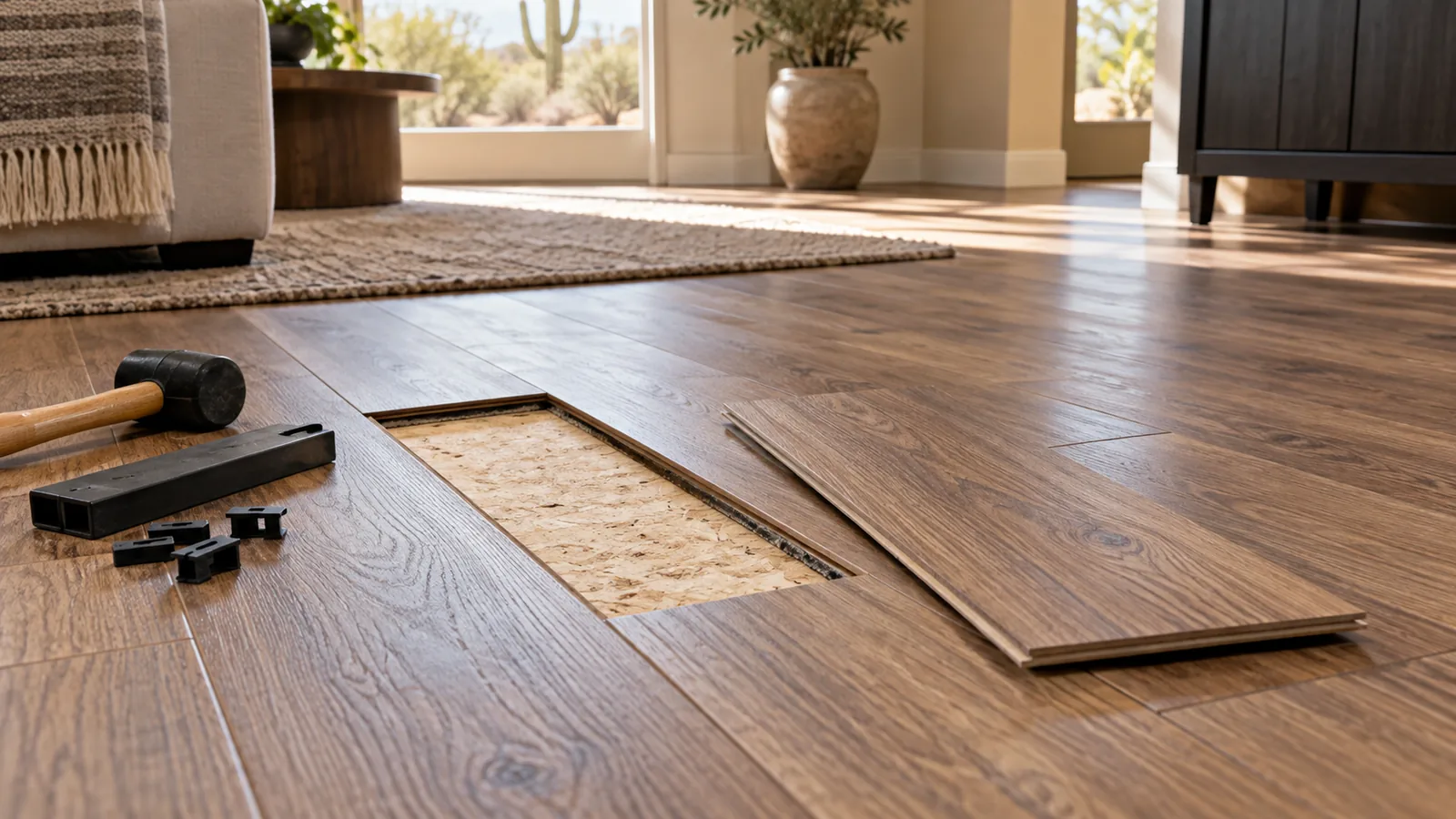
Before cosmetic repairs: Ongoing leaks, movement, sagging, suspected mold and structural damage need specialist evaluation. Identify and resolve the cause before patching or painting. This guide does not make structural repairs or major trade work part of a handyman quote.
You walk across them every single day, dragging groceries in, chasing the dog, or just shuffling to the coffee pot in the morning. It’s usually only when you hear that ominous crack under a tile, or feel a weird “squishy” spot in the laminate, that you look down. Naturally, the first thought is usually about how it looks. Is it ugly? Will guests notice? But here is the thing: ignoring those little imperfections isn’t just a cosmetic gamble; it’s a functional risk that can bite you in the wallet later.
Wait, It’s More Than Just a Cracked Tile?
You might think a loose floorboard or a chipped ceramic tile is just an eyesore. And sure, it definitely doesn’t help the vibe of your living room. But floors are the workhorses of your home.
When a tile cracks or a plank lifts, your floor is telling you that the structural integrity of that spot has been compromised. It’s no longer sealing out moisture or distributing weight evenly.
Think of it like a cavity in a tooth. By the time you see the dark spot on the surface, the damage underneath, in the soft, vulnerable parts, might be spreading. Floors work the same way. A hairline crack in the grout allows water from your mop (or a spilled drink) to seep down to the subfloor . Over time, that moisture gets trapped. Not always. Trapped moisture under flooring can lead to mold or wood rot, turning a hundred-dollar repair into a major renovation project.
The “Trip and Fall” Factor
If you have young kids running around or aging parents coming to visit, a transition strip that is peeling up or a tile that sits a quarter-inch higher than the rest is a legitimate hazard. The planks can separate or “gap” at the ends, creating a lip that catches socks and shoes.
Review the scope before hiring
- Lifting Laminate: Moisture or lack of expansion gaps causes boards to peak.
- Cracked Grout: Sharp edges can actually cut bare feet.
- Loose Carpet: Ripples in the carpet are easy to snag a toe on.
- Wobbly Tiles: A tile that moves when you step on it throws off your balance.
Fixing these isn’t about vanity; it’s about peace of mind. You shouldn’t have to subconsciously memorize a “safe path” through your own hallway just to avoid tripping.
The Arizona Effect: Why Chandler Floors Act Weird
Living in the East Valley means dealing with an environment that is pretty tough on building materials.
Here’s the thing many homeowners don’t realize: your house moves. It expands when it’s hot and contracts when it cools down. If your flooring was installed without the proper expansion gaps, or if the expansion joints in your concrete slab were ignored, your floor is going to fight back.
This is crazy to see if you haven’t experienced it. It happens when tiles are bonded too tightly with nowhere to move. The pressure builds up until, pop, the tiles literally explode upward off the floor, forming a little tent. It sounds like a gunshot.
The Role of the Concrete Slab
Most homes here are built on concrete slabs. Concrete is durable, but it’s not invincible. It cracks as it settles. If your flooring installer didn’t use a crack isolation membrane (a fancy layer that separates the tile from the concrete movement), those slab cracks will telegraph right up through your expensive travertine or porcelain.
Expert floor repair involves diagnosing why the crack happened, not just filling it with spackle and hoping for the best. Is the concrete shifting? Did the adhesive fail? If you just patch the top without fixing the bottom, you’ll be doing it again in six months.
Troubleshooting: What Your Floor is Trying to Tell You
Sometimes it helps to break down exactly what you are seeing versus what is actually happening. It’s easy to misdiagnose these things if you aren’t looking at floors all day long.
| What You See/Hear | The Likely Culprit | The Functional Risk |
|---|---|---|
| Hollow sound when tapping tile | The bond between the tile and subfloor has failed (delamination). | The tile will eventually crack or shatter under weight. |
| Gaps opening between planks | Humidity changes or failed locking mechanisms. | Dirt and moisture get in the cracks, ruining the subfloor. |
| Carpet rippling or bunching | The backing has stretched or tacks strips failed. | Major trip hazard and wears out the carpet fibers faster. |
| Discolored wood/laminate | Water damage from below or a slow leak. | Mold growth and rotting subfloor joists (if on a raised foundation). |
Repair vs. Replacement: Saving Money in the Long Run
There is a misconception that if a floor is damaged, the whole room has to be ripped out. Honestly? That’s rarely the case if you catch it early.
Let’s say you have a few chipped tiles in the kitchen. Finding a match can be tough, sure.
It saves a mess, saves money, and restores the structural strength of the floor.
The Cost of Waiting
If you ignore a loose plank in a floating floor, the movement destroys the locking mechanism on the surrounding planks. Suddenly, a one-board repair turns into a ten-board repair. Or worse, you have to replace the whole room because the new batch of flooring won’t click into the old, broken mechanisms.
Why DIY Often Fails Here
Painting a wall? Go for it. Changing a light fixture? absolutely. But floor repair is deceptive. It looks easy on YouTube, but the materials are unforgiving.
For instance, mixing thinset mortar or grout seems like baking a cake, but the chemistry matters. If you mix it too dry, it won’t bond. Too wet? It shrinks and cracks. If you don’t get the old adhesive up completely, the new piece will never sit flush. You’ll end up with a relentless “lip” that catches your toe every time you walk by.
There’s also the tool situation. To fix a floor properly, you might need a wet saw, an oscillating tool, a heavy-duty floor scraper, and specific trowel sizes. Buying all that gear for a one-time repair usually costs more than just hiring a pro to knock it out in an afternoon.
The “Invisible” Comfort Factor
There is something psychologically draining about a broken house. Every time you step on that squeaky board or see that cracked tile, your brain registers a tiny bit of stress. It’s a reminder of a “to-do” list that never ends.
When the floors are solid, silent, and smooth, the house just feels… better. It feels well-built.
Beyond that, proper repairs help with insulation and efficiency . Large gaps in baseboards or flooring near exterior walls can actually let drafts in (or let that precious A/C out). Sealing up gaps in the flooring perimeter isn’t just about looks; it’s about tightening the envelope of your home.
Let’s Get Your Floors Back on Solid Ground
Don’t wait for that loose tile to crack or that trip hazard to cause an injury. Your floors do a lot of heavy lifting for your home, give them the attention they deserve so they can keep doing their job.
Ready to fix that floor?
Or simply Request a Free Quote online.
Let’s make your home solid again.
Discuss a suitable repair
East Valley Handyman handles practical repair, mounting, assembly, patching and finish projects in Chandler and the East Valley. Send the project details so the scope can be reviewed before scheduling. Major trade work, structural repairs and permit-dependent projects need the appropriate licensed specialist.
Need a hand with a project?
Tell us what needs attention, where the work is and what you have in mind. We serve Chandler and the surrounding East Valley.
Request a free quote →