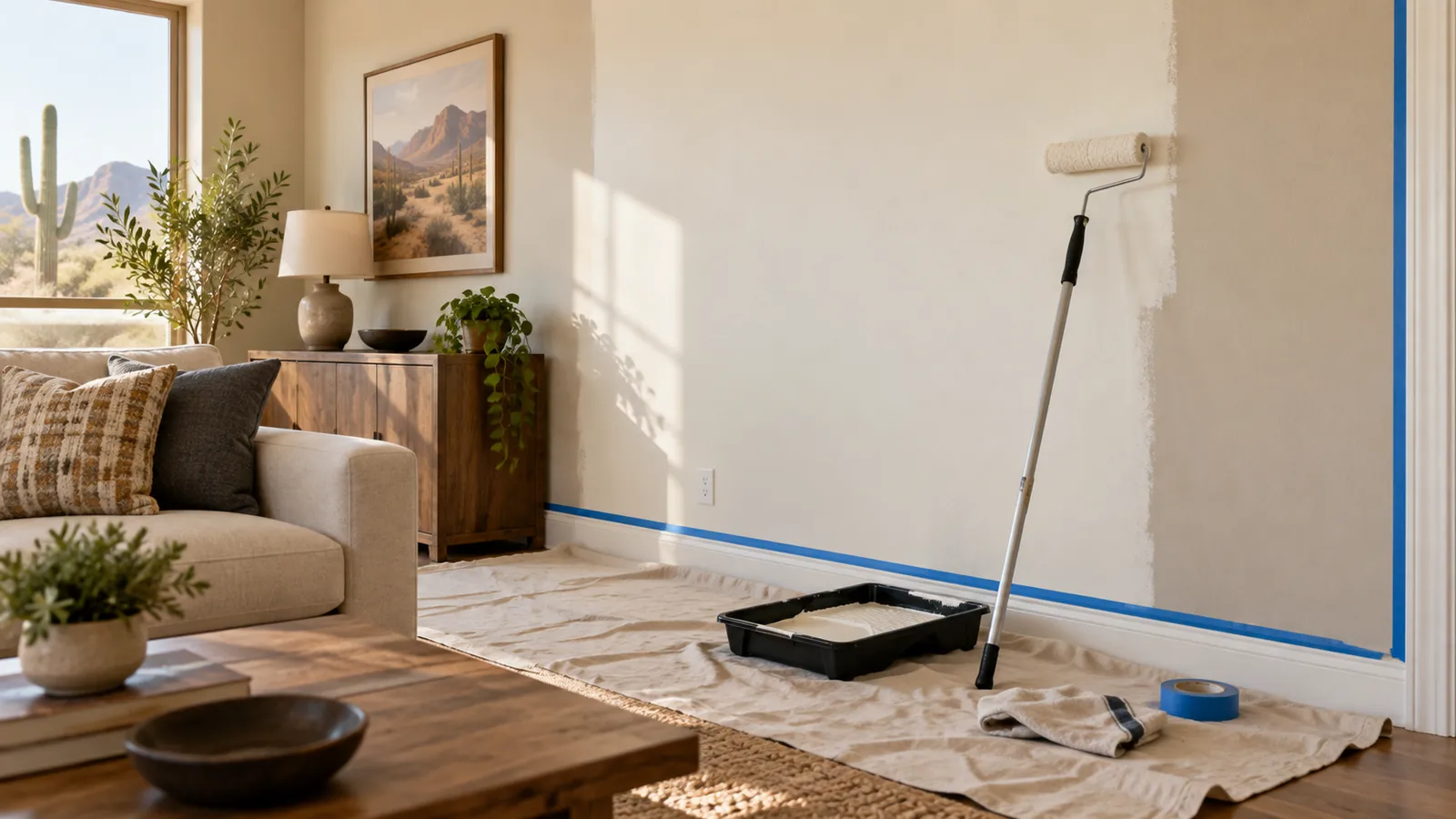
You stare at that beige wall in your hallway and think, “A fresh coat of paint would change everything.” But then you spot the nail pops, the scuff marks from the dog, and that weird texture patch from three years ago that never looked quite right. Honestly, painting is rarely just about painting; it’s about fixing the canvas first.
It’s Never Just About the Paint
Here’s the thing about painting projects that most people don’t realize until they’re standing in the middle of a room covered in plastic sheeting: walls take a beating. You might call a dedicated painting crew, and sure, they are fantastic at applying color. But if there’s a hole in the drywall or a piece of baseboard that’s come loose? They might just paint right over it.
That’s where the “Painting Handyman” concept really starts to make sense.
It’s about home maintenance as a whole, rather than just changing a color.
A homeowner wants to update a bathroom, but there’s a little bit of water damage near the shower surround. A specialized painter might tell you to call a carpenter or a drywall guy first, pushing your schedule back weeks. A handyman? One person, one visit, zero headaches.
The “Small Job” Dilemma
Have you ever tried to get a big painting contractor to come out and paint just a powder room or a single accent wall? It can be frustrating. Many large companies have minimum job requirements because they have big crews and overhead. Mobilizing a van full of equipment for a half-day job just doesn’t make sense for them financially.
Here is a quick breakdown of how the scope usually differs:
A larger painting job and a small patch have different preparation, material and scheduling needs. Ask each provider about minimum charges, preparation, product choices and which repairs are included rather than assuming a universal price or scope.
It’s too small for the big guys, but too tricky for a DIY weekend if you want it to last.
Texture Matching: The Arizona Art Form
Let’s talk about texture for a second. If you live in the East Valley, you probably have textured walls.
Applying paint is the easy part. The hard part, the part that makes a repair invisible, is matching that texture. If you patch a hole and just paint over it, you end up with a smooth bald spot on a textured wall. It sticks out like a sore thumb every time the light hits it.
A skilled painting handyman has to be part artist. It’s a messy, fussy business, but getting it right is the difference between a “professional look” and a “landlord special.”
The “While You’re At It” List
Hiring a multi-skilled professional allows you to tackle that nagging “To-Do” list that has been growing on your fridge.
- Replace the light fixtures to match the new color scheme.
- Install new blinds or curtain rods once the paint dries.
- Swap out outlets and switches from beige to white to look cleaner.
It is incredibly efficient. Instead of coordinating three different contractors, an electrician, a blind installer, and a painter, you just have one person handling the workflow. It saves you money on multiple trip charges, and it saves you the stress of letting strangers into your house three different days of the week.
Prepping is 80% of the Job
You might have heard this before, but it bears repeating: a good paint job is 80% preparation and 20% painting.
Surface preparation involves more than just throwing down a drop cloth. It means washing down walls to remove grease (especially in kitchens), sanding down glossy surfaces so the new paint bonds, and using the right primer for the job.
The intense heat causes thermal expansion and contraction, leading to hairline cracks on the exterior, or even around interior window frames. If you just paint over these, they crack again in six months. A handyman approach involves digging out the crack, filling it with an elastomeric compound that stretches, and then painting.
Understanding Paint Types (Without the Jargon)
Walk into a hardware store, and the aisle of paints can be overwhelming. Flat, eggshell, satin, semi-gloss, high-gloss. Enamel? Latex? Oil-based?
For example, a lot of people love the look of flat paint because it hides imperfections in the drywall. But if you have kids or dogs? Do not do it. You can’t scrub flat paint. As soon as you take a wet sponge to it, you’ll rub the finish right off.
It has just enough sheen to be wipeable, but not so much that it looks shiny and dated.
And let’s talk about “Paint and Primer in One.” It’s a great marketing term, but it’s not magic. If you are painting over a dark red wall with a light gray, “Paint and Primer in One” isn’t going to cut it. You’re going to need a dedicated primer coat, or you’ll be buying five gallons of expensive topcoat trying to hide that red.
Safety and the High Stuff
Let’s be honest for a second. Painting is tiring. But painting vaulted ceilings or the peaks of a two-story entryway? That can be dangerous.
Plus, cutting in, that’s the process of painting a straight line where the wall meets the ceiling, is really difficult to do when your legs are shaking from being 12 feet up in the air.
The Value of a Relationship
When you hire a massive company, you are an invoice number.
There is a comfort in having a “house guy.” Someone you trust with the gate code. Someone who knows that the back door sticks when it rains.
Ready to Refresh Your Home?
Or click here to [Request a Free Quote]
Discuss a suitable repair
East Valley Handyman handles practical repair, mounting, assembly, patching and finish projects in Chandler and the East Valley. Send the project details so the scope can be reviewed before scheduling. Major trade work, structural repairs and permit-dependent projects need the appropriate licensed specialist.
Need a hand with a project?
Tell us what needs attention, where the work is and what you have in mind. We serve Chandler and the surrounding East Valley.
Request a free quote →