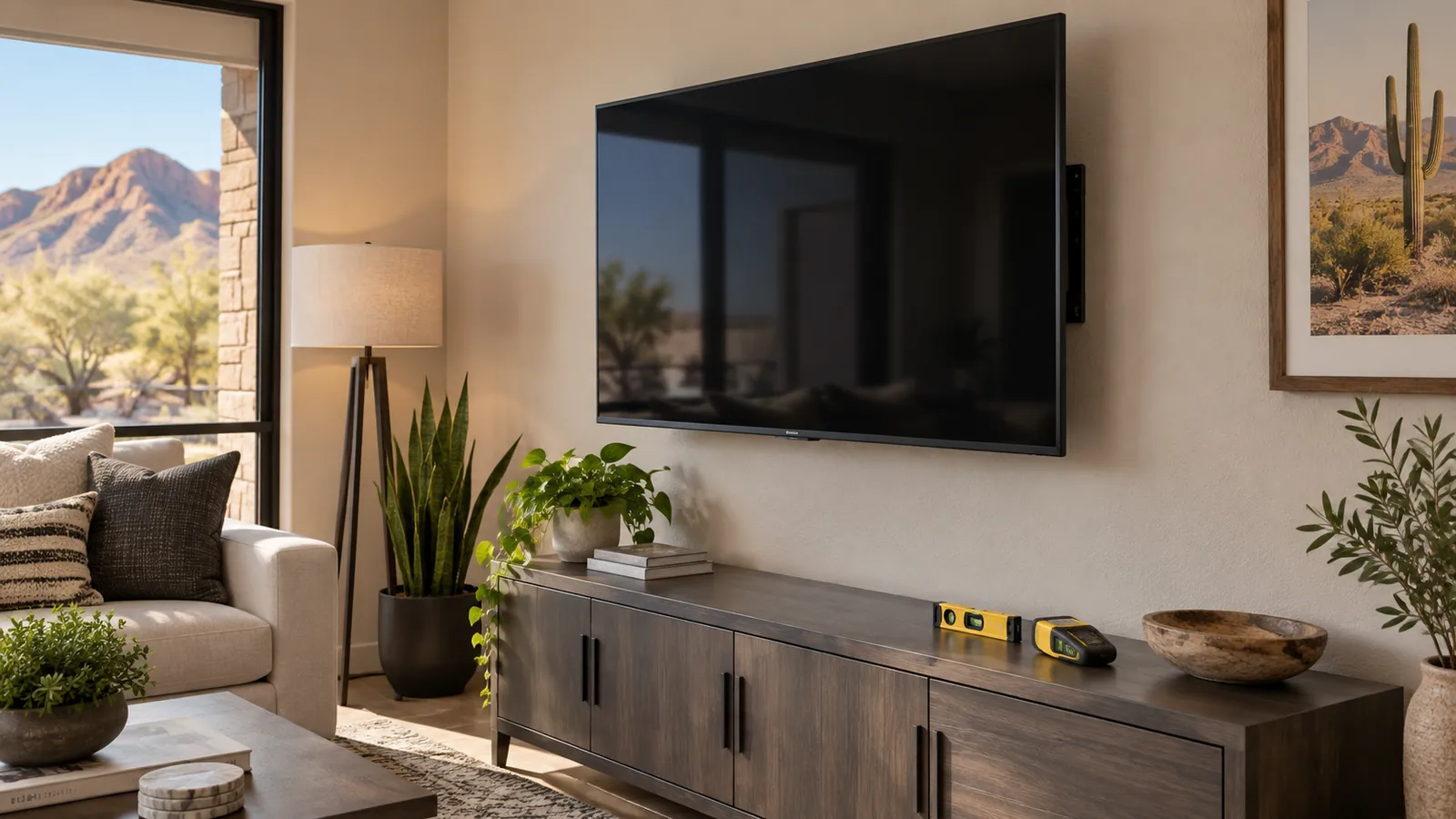
You’ve finally done it, you bought that sleek, 75-inch 4K television that’s going to completely change how you watch Sunday football or your favorite streaming series. It’s sitting there in the massive cardboard box, taking up half your living room, and now you’re staring at the blank wall where it’s supposed to live. It seems simple enough on paper, but looking at that expanse of drywall, you start to get a nagging feeling that maybe, just maybe, this involves a little more than a screwdriver and a prayer.
The “It’s Just Four Screws” Myth
A homeowner watches a three-minute tutorial video, grabs a power drill, and figures they can knock this out before lunch. Honestly, the confidence is admirable. But there is a massive difference between putting holes in a wall and securely mounting a heavy electronic device .
You know what? The manufacturers of these mounts don’t help much. They include a little baggie of hardware that looks like it belongs in a toy set. Those plastic anchors?
When you try to hang a TV yourself, you’re not just battling gravity; you’re battling the unknown behind your paint. If you miss the stud by even a fraction of an inch, or if you use the wrong type of toggle bolt for a metal stud (which are surprisingly common in some newer East Valley builds), you aren’t just risking a crooked TV. You’re risking the horrifying sound of drywall crumbing followed by the crash of your brand-new screen hitting the floor.
Understanding What’s Behind Your Walls
Let’s talk about what makes a house standing in the desert unique. In older neighborhoods, you might find standard wood studs spaced 16 inches apart. That’s the dream scenario. But in many newer tract homes or remodeled spaces, the construction can be a bit more unpredictable.
Sometimes the studs are 24 inches apart. Sometimes, you’re drilling into a furring strip that’s barely attached to a block wall. If you don’t know the difference between a load-bearing stud and a decorative architectural feature, you’re playing a dangerous game.
The Stud Finder Struggle
Have you ever used a stud finder that beeped at everything? Or maybe it beeped at nothing? It’s frustrating. Most consumer-grade stud finders give false positives because they pick up density changes that aren’t wood.
- Pipes: Drill into a water line, and you have an immediate flood.
- Electrical Wires: Drill into a live wire, and you have a safety hazard (and a blown breaker).
- HVAC Ducts: Drill here, and your screw just spins endlessly in sheet metal.
A professional handyman uses magnetic stud finders or high-end density scanners to verify the center of the stud, not just the edge. It’s about triangulation, finding the stud, verifying the spacing, and knowing exactly what kind of fastener will hold 50+ pounds of static weight.
Physics 101: The Mount Matters
Not all mounts are created equal, and neither are the forces they exert on your wall. This is where a lot of people get tripped up. They buy a mount online because it was on sale, not realizing it might not be right for their specific room layout or TV weight.
Here is a quick breakdown of how different mounts change the game:
| Mount Type | The Physics | Complexity Level |
|---|---|---|
| Fixed / Low Profile | Holds the TV flat against the wall. The weight is shearing (straight down). | Moderate. Requires precise leveling. |
| Tilting Mount | Allows the TV to angle down. Adds slight leverage away from the wall. | Moderate to Hard. Good for high placements (like above fireplaces). |
| Full-Motion (Articulating) | The arm extends out. This creates a lever, multiplying the force (torque) on the wall anchors. | Expert. Requires hitting two studs perfectly. |
See that last one? The full-motion mount. That is the widow-maker of DIY projects. When you pull a 60-pound TV two feet away from the wall, the force pulling on those top screws increases dramatically. If those screws aren’t centered in the heart of a sturdy wooden stud, the mount can rip right out of the wall.
The Art of Cable Management
Let’s be honest for a second. Nothing ruins the look of a sleek, “floating” television like a nest of black cables dangling down the wall. It looks temporary. It looks messy.
Hiding wires isn’t just about shoving them behind the TV stand. If you want that clean, magazine-ready look, the wires need to go inside the wall. But, and this is a big but, you can’t just run your standard TV power cord through the drywall. That is actually against fire code in most places, including here in Arizona. Standard power cords aren’t rated for in-wall heat buildup.
Professional TV Mounting involves installing an in-wall power kit (often called a bridge kit) that essentially extends an outlet up behind the TV legally and safely.
The result? A television that looks like a piece of moving art, with zero clutter. It’s a small detail that makes a room feel finished. You know how good it feels when you organize a junk drawer? It’s like that, but for your living room wall.
Height and Viewing Angles: Save Your Neck
There is a strange phenomenon where people mount their TVs way too high. Everyone wants the TV above the mantel, but nobody wants to crane their neck like they are sitting in the front row of a movie theater.
Ideally, the center of the screen should be at eye level when you are seated. If you do have to mount it high (like over a fireplace), you absolutely need a tilting mount to angle the screen down toward the viewer.
This is where an expert opinion comes in handy. It’s a mix of math and comfort. If you get it wrong, you won’t notice it immediately, but two months later, you’ll wonder why your neck hurts after a Netflix binge.
Tools of the Trade
You might have a drill. Maybe even a decent one.
Speaking of lag bolts, these are the unsung heroes of home improvement. A standard screw might hold a picture frame. A lag bolt holds a deck together. It’s that level of security that lets you sleep at night, knowing the cat isn’t going to knock the TV onto the floor.
The “Oops” Factor
A homeowner drills a hole. It’s loose. They try to patch it, move over two inches, and drill again. Now they have a Swiss cheese wall.
Patching and texturing drywall to match the surrounding area is an art form in itself. If you mess up the mount, you aren’t just left with a TV on the floor; you’re left with a wall repair project that requires mud, tape, sanding, and paint matching.
By hiring a professional from the start, you bypass the “oops” phase entirely.
Why Expertise Matters in Chandler
Chandler homes have character. From the stucco exteriors to the unique interior layouts, no two jobs are exactly the same. You might have a stone veneer feature wall. Drilling into stone requires masonry bits and a hammer drill, plus a steady hand to keep the stone from cracking.
Or maybe you want to mount a TV on the patio for those beautiful Arizona winter evenings. Outdoor mounting brings its own set of challenges, weatherproofing, glare reduction, and securing against wind.
You are paying for the experience of hundreds of installs.
- Metal studs in condos.
- Brick and block walls.
- Plaster that crumbles if you look at it wrong.
- Recessed mounts for a flush finish.
The Value of Time and Peace of Mind
Think about what your Saturday afternoon is worth. Do you really want to spend it sweating, arguing with a tape measure, and making three trips to the hardware store because you bought the wrong size anchors?
There is a tremendous relief in watching a pro handle it. You just sit back and get the remote ready.
Plus, there is the safety aspect. Modern TVs are lighter than the old tube sets, but they are top-heavy and fragile. Securing them properly is a safety measure for your pets and children. A properly mounted TV is earthquake-resistant and bump-resistant.
Ready to Transform Your Living Space?
Don’t let that new TV sit in the box another day, and definitely don’t risk your drywall trying to wrestle it onto the wall yourself. Let the experts handle the heavy lifting and the technical details so you can get straight to the popcorn and movies.
Let’s get that TV up on the wall where it belongs.
Discuss a suitable repair
East Valley Handyman handles practical repair, mounting, assembly, patching and finish projects in Chandler and the East Valley. Send the project details so the scope can be reviewed before scheduling. Major trade work, structural repairs and permit-dependent projects need the appropriate licensed specialist.
Need a hand with a project?
Tell us what needs attention, where the work is and what you have in mind. We serve Chandler and the surrounding East Valley.
Request a free quote →